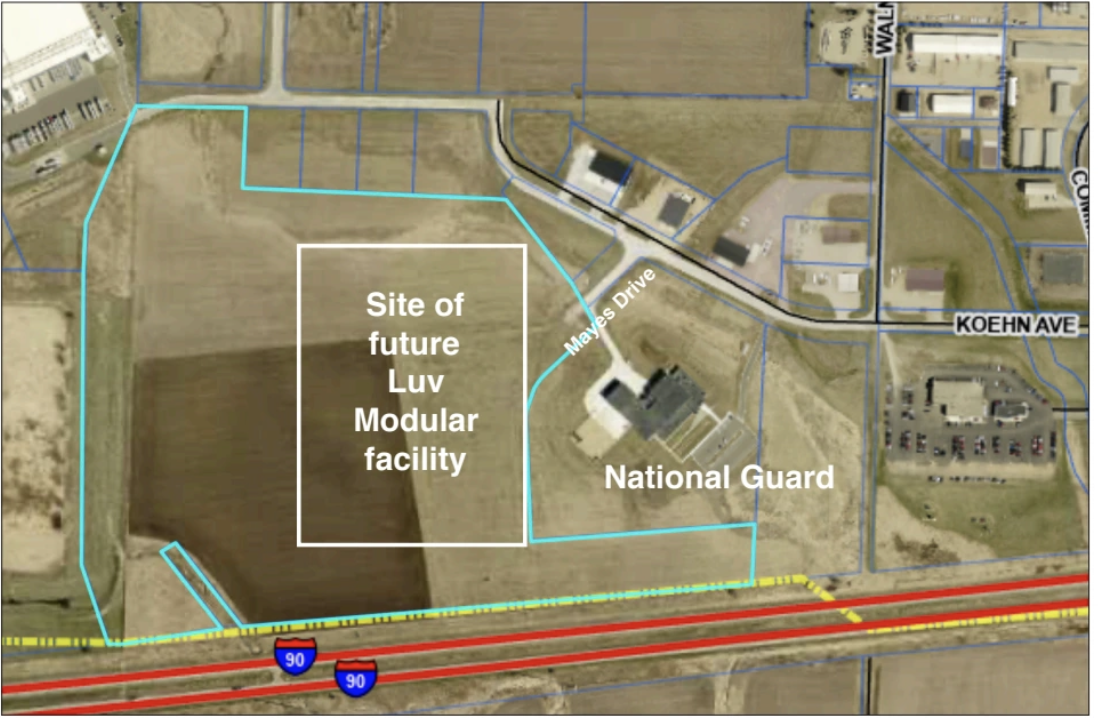


A 176,760-square-foot manufacturing facility is coming to a 15-acre site in Luverne’s industrial park and will require 125 full-time employees at a $9 million annual payroll.
That’s according to Don Jahnke, Luverne, who presented information about his company, Luv Modular LLC, to the Luverne Economic Development Authority Monday.
“What we’re proposing to build is a factory to build housing inside,” he told the LEDA Board.
Jahnke explained that the footprint of the main building will be a little over 100,000 square feet with offices and a second facility tied to it.
The facility will be built west of the National Guard Readiness Center, and Jahnke said he’s been working with city staff and engineers on site development options, roads, access, utilities and storm water management.
EDA director Holly Sammons said it’s possible her office would apply for a Business Development Public Infrastructure grant for road and utility improvements.
“If Mayes Drive were to be extended, we could get four different lots on the north side of the road,” she said. “We could serve this 15-acre site and have a remainder of the 10 or 12 acres (to the west).”
In the short term, she said a gravel road could provide access for Jahnke’s factory site work, which will begin this spring or summer.
Year-round, indoor housing production
At Monday’s meeting, Jahnke offered a tutorial on how his modular production facility would work.
“The production goes up to 6,000 square feet per day. Everything is built to be high performance,” he said.
“What’s nice with modular is we can have a 500-mile radius for shipping, and we’ve done projects up to 1,000 miles, and it’s still profitable. So it allows us to grow into it.”
He said the real value of modular production is the indoor, controlled setting.
“We’ve really pushed the fact that you build year-round,” Jahnke said.
“Of course, with our weather the critical thing around here is we die off in the winter. But this allows construction to cycle year-round.”
He said the Luverne facility will focus on building rental properties — duplexes, fourplexes, on up to multi-story multi-unit buildings.
He said they won’t be building custom homes. “It’s not that we can’t; it’s just that this factory isn’t set up for that as a primary focus,” Jahnke said.
“It’s not that we’re competing with the local trades here. We’re not going after the custom home market.”
He showed how a basic floor plan of an apartment building in a modular plant is cut into boxes.
“That’s why we look at being able to make boxes that are 80 feet long, so we can make an entire cross section of a module, not just a room, per se,” Jahnke said.
Access to I-90
He said access to I-90 is critical for transporting modular construction.
“An average box is 16 feet wide, so single-lane highways make it much more difficult and a lot more costly,” Jahnke said, adding that a single-lane roadway can add up to $6 or $7 per mile per box.
“That was why we focused on the piece of property that was just west of the armory.”
He said the factory itself will be a steel frame building wrapped in SIP (structural insulated panels) panels. The mezzanine decks will be built out of cross laminated timbers.
“Everything’s focused on being as energy efficient as we can,” Jahnke said. “Our focus is to cut our carbon footprint and build above code with the team we have.”
The building will be heated with a couple boilers and radiant heat, and he said it won’t require much from the city in terms of water, sewer and electricity.
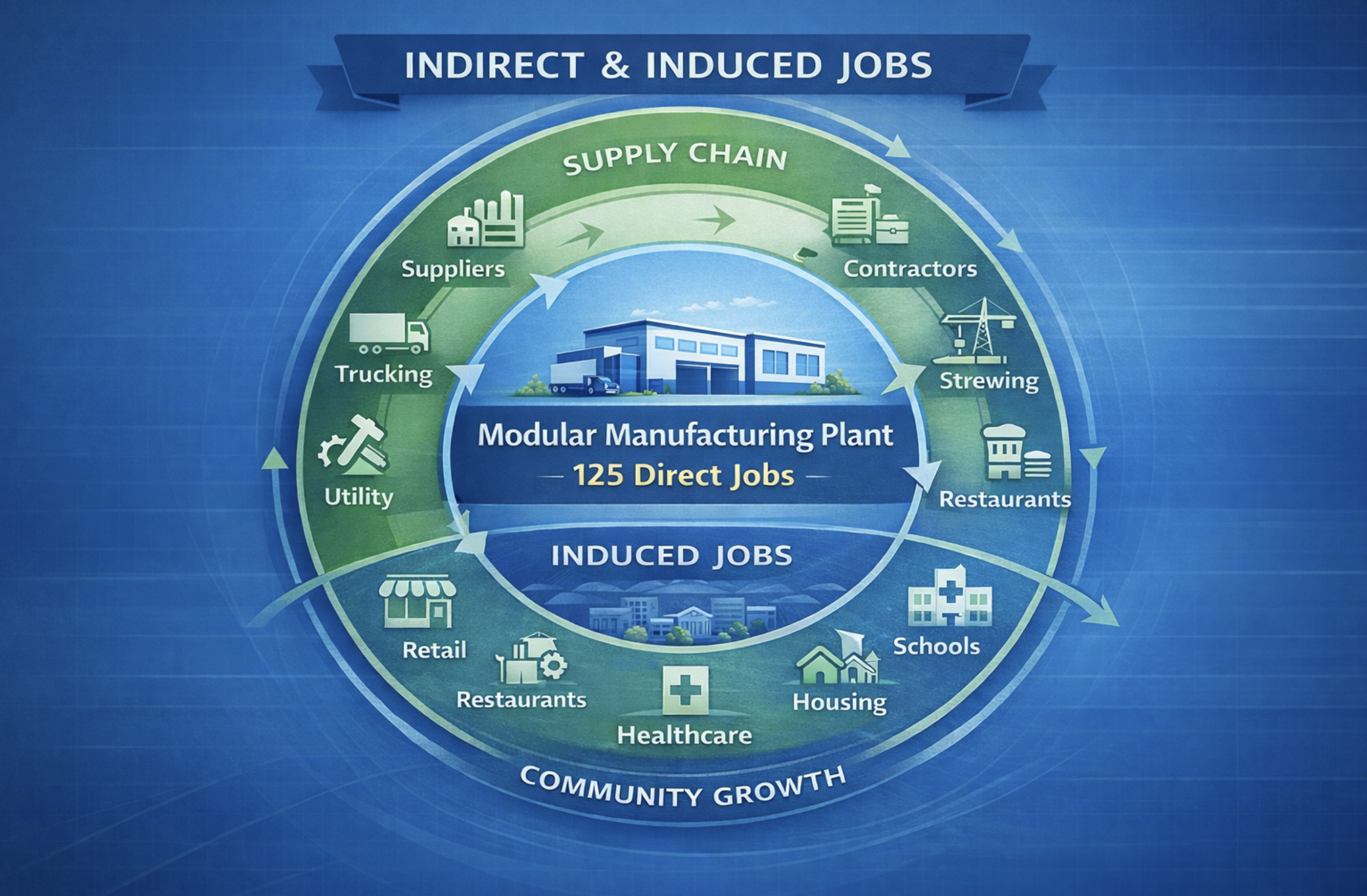
Don Jahnke shared the above graphic with Luverne city officials showing the direct and indirect effect of the LUv Modular jobs on the local economy.
Supporting Luverne
Jahnke said production would start with 79 employees and then ramp up to up to 150 employees.
He said the plant has two contracts committed that will fulfill one year’s production for plant employees.
The mix of employees, Jahnke said, will be similar to what’s found on a building project site, except they’re working inside.
“It will give us a good cross section of income for the area, and that just allows that to move back into the community with those wages and be able to support what we already have in the city,” Jahnke said.
“What’s nice is now we can be building projects in a town 250 miles away and we get the benefits of the workers in our town. That’s why we liked the idea that this can support the community.”
He said his business will generate property taxes between $400,000 and $600,000.
“We’re not asking for tax abatement,” Jahnke said. “We want this to be a sustainable project for the community. Hopefully it will start bringing people.”
He said he and his business partners have been planning this venture for several years, and he has long been advocating to build it in Luverne.
“I live here and I love this town,” said Jahnke, who has lived in Luverne for 10 years.
“Our different members have sat in on city councils in different towns, and all of them have expressed the fact that this is the town that understands how to grow. And that’s what’s allowed them to be more than willing to put the plant here. So, we really appreciate what the town has done, and we hope we can be good member of that with this industry.”
Mayor Pat Baustian said, “This is wonderful news. A wonderful project.”
Sammons said the next steps would be the platting process and development agreement, and the final step will be to come back with formal proposal to the EDA to purchase the 15-acre site with a legal description.
“There will be a lot of things to cover between now and then as they finalize their business plan and their financing, and we work on our utility side,” she said.