

Five Rock County 4-H'ers compete at regional dog show

Rebecca Austin will represent Rock County at the upcoming Minnesota State 4-H Dog Show at the Minnesota State Fairgrounds in Falcon Heights.
Austin earned grand champion honors at the Southwest Minnesota Regional Dog Show Aug. 7 at the Nobles County Fairgrounds in Worthington.
She won each of her intermediate division classes.
The winning classes included beginner agility and obedience, jumpers I, and pre-novice rally.
Other dog handlers from Rock County included Brooke Feit, Jo-Hannah Ladd, Mary-Frances Ladd and Michaella Sandbulte.
Each competed in the senior division.
Feit earned reserve champion ribbons in jumpers I, beginner obedience and pre-novice rally. She earned a blue ribbon in beginner agility.
Jo-Hannah Ladd earned reserve champion honors in novice obedience and jumpers II. She received blue ribbons in advanced rally and intermediate agility.
Mary-Frances Ladd received a grand champion ribbon in pre-advance rally and blue ribbons in novice obedience, jumpers II and advanced rally. She received a red ribbon in senior agility.
Sandbulte earned purple ribbons in pre-novice rally, beginner obedience and jumpers I. She received a blue ribbon in beginner agility.
Joining Rock County at the regional dog show event were 4-H’ers from Nobles, Murray and Jackson counties.
The state dog show takes place Sept. 23-24.

Now is the best time to attack broad leaf weeds

For weed spray to be most effective, the weeds should be growing actively ... with all the rain we have had, the weeds ARE really growing actively.
So, I’m saying that right now is a great time to attack creeping Charlie and any other broad leaf weed in your lawn. A fall application of spray will catch the weed seedlings as they germinate, giving you a clean sweep going into spring. Tough weeds like creeping Charlie will often require more than one spray application, so hitting it now will give you another opportunity to have at it in six weeks.
All this wonderful moisture has encouraged the slugs to have a picnic on hostas. Slug bait applied around the base of the plant will give the hostas a fighting chance … without it, they’re pretty much “shot full” of holes for the rest of the season.
If you are thinking of rearranging some of your perennials or adding some new ones to fill in gaps or color accents, now is a great time to do that. If you don’t have time right this very minute, take a picture so you can remember how and where you want to make those changes. We all are pretty good at procrastination so a picture is a good reminder and/or encourager to pursue that project when you have a few extra seconds in your schedule.
Also, if you go seeking professional advice, the picture helps the adviser visualize the setting as well as what other plants are involved in the garden area.
 

Barbara Ball death notice

Barbara Ball
Barbara Ball, 84, Luverne, died Sunday, Aug. 27, 2017, at the Sanford USD Medical Center in Sioux Falls, South Dakota.
A funeral service will be at 10:30 a.m. Friday, Sept. 1, at the United Methodist Church in Luverne. Burial will be in the Maplewood Cemetery in Luverne. Visitation will be from 4-7 p.m. Thursday, Aug. 31, at the Dingmann Funeral Home in Luverne, and also one hour prior to the service at the church Friday.
Arrangements are by Dingmann Funeral Home of Luverne, dingmannandsons.com.
 (0831 DN)

Florence Thomas

Florence Thomas
Florence (Dot) Thomas of Sioux Falls, South Dakota, died Thursday, Aug. 24, 2017, just shy of her 99th birthday.
Memorial services were Monday, Aug. 28, 2017, at Our Savior's Lutheran Church, Sioux Falls.
Florence Marie (Dot)  Devick was born Sept. 16, 1918, to Saebjorn and Amanda Devick. Dot was raised in Colton, South Dakota, with her seven siblings, Harold, Sara, Norman, Perry, Alma, John Stanley (Bud), and Mable Ione (Sis). She graduated from Colton High in 1936 and earned her Bachelor of Arts degree from Augustana College in 1940.
On March 23, 1941, Dot married Russell Thomas at First Lutheran Church in Sioux Falls. During World War II Dot worked as an executive secretary at John Morrell. When Russ came home, their mutual focus was family. Dot was involved in the church and was invited to help form a new Lutheran church in Sioux Falls. She became one of the founders of Our Savior's Lutheran Church which initially held its services at Augustana College. She spent many years teaching Sunday school and coordinating teachers at the church.
Dot became Parish Education Director at Our Savior's. She taught confirmation, was a board member of Lutherans Outdoors, was instrumental in the development of the camping programs, Boundary Waters canoe trips, Bible school trips to Rosebud Reservation, and youth leagues including those for special needs kids. She was also very involved in the Augustana Alumni Association.
Dot and Russ loved camping with their children took them to many of the national parks. They also renovated a lake cabin on Lake Carlos near Alexandria and hosted large extended family reunions.
Florence is survived by her children, Jane Thomas, Lesa Thomas, Julie Thomas (Michael Collins), Michael Thomas (David Thompson), Jeff Thomas (Jackie Thomas), Steve Thomas (Pat Reagan); her grandchildren, Maren Tollefson, Ian Thomas, Jason Thomas, Aaron Dafoe, Leif Thomas, Kristin DeWitt, Ross Dafoe and step-grandchild, Carly Dockstader; 11 great-grandchildren; three great-great-grandchildren; and many nieces, nephews, and cousins.
She was preceded in death by her husband, Russell Thomas, and all of her siblings.
Arrangements were by Heritage Funeral Home of Sioux Falls, www.heritagesfsd.com.
 (0831 F)

Harvey Rozeboom

Harvey Rozeboom
Harvey Allen Rozeboom, 81, Hills, died Saturday, Aug. 19, 2017, at the Tuff Memorial Home in Hills.
A funeral service was Wednesday, Aug. 23, at the Steen Reformed Church in Steen. Burial followed at East Side Cemetery in Steen.
Harvey Rozeboom was born Sept. 9, 1935, to Bert and Hattie (Van Batavia) Rozeboom. He grew up in Hills and attended country school there.
On June 14, 1957, Harvey married Gertrude Mae Teune. They farmed near Hills. Harvey was a member of the Steen Reformed Church in Steen. His hobbies and interests included farming, fishing, woodworking, and spending time with his family, especially his grandchildren and great-grandchildren.
Harvey is survived by his wife, Gertrude Rozeboom, Hills; four children, Harlin (Yvonne) Rozeboom, Hills, Lowell (Karla) Rozeboom, Garretson, South Dakota, JoLean (Gary) Greenhoff, Pipestone, and BernDean (Gary) DeRuyter, Lake Benton; a daughter-in-law, Barb Rozeboom, Holland; 12 grandchildren, four stepgrandchildren; 21 great-grandchildren; and three stepgreat-grandchildren; a twin sister, Burdette Oelrich, Hull, Iowa; and many nieces, nephews and other relatives and friends.
He was preceded in death by his parents; a son, Arlin Rozeboom; two brothers, John and Jim Rozeboom; and a brother-in-law, Chuck Oelrich.
Arrangements were by Jurrens Funeral Home of Hills, www.jurrensfuneralhome.com.
(0831 F)

Helen Biren

Helen Biren
Helen Marie Margaret (Stroh) Biren died Friday, August 25, 2017, at Koda Community Living in Owatonna, of complications from Parkinson’s Disease.
Helen was born May 22, 1936, in Luverne, Minnesota, the daughter of Jerry Stroh and Effie (Anderson) Stroh. After graduating high school, she attended Augustana College in Sioux Falls and then began her teaching career in Pipestone, Minnesota. She also taught in Great Falls, Montana, Hutchinson, Minnesota, and Owatonna, Minnesota, until she retired in 1993. On August 30, 1986, she married Chris Biren. She was a devoted wife to Chris until his death in 1990. Helen was an active member of the Trinity Lutheran Church and Sarah Circle and did volunteer work at the Pink Pantry in the hospital. She was a fabulous cook and loved family, friends, laughing, playing cards, gardening, knitting and hardanger. Helen had wonderful, devoted friends that were there helping her through her journey with Parkinson’s.
She is survived by her brother, Harold (Carol) Stroh and sister-in-law, Judy Stroh, all of Luverne, Minnesota; five step-children, Mark (Dee Dee) Biren of Golden, Colorado, Shelly (Marc Chamberlain) Biren of Seattle, Washington, Tom Biren of Arvada, Colorado, Marcie (Ken) Beyersdorf of Tucson, Arizona, and Beth (Eric) Eppers of Atlanta, Georgia; several step-grandchildren and many nieces and nephews.
She was preceded in death by her parents, Jerry and Effie Stroh; husband, Chris Biren and brothers, David and Rodney Stroh.
Helen’s family would like to say a special “Thank You” to her friends, Rosie, Ken, B.J., Dorothy, Elda and Ginny.
Visitation will be at Michaelson Funeral Home on Monday, August 28, 2017, from 4:00 – 7:00 p.m. and at church on Tuesday one hour prior to the service. Funeral services will be held 1:00 p.m. on Tuesday, August 29, 2017, at Trinity Lutheran Church in Owatonna followed by a lunch reception at Michaelson Funeral Home.
Interment will be 11:00 a.m. on Wednesday, August 30, 2017 in St. Leo Cemetery in Pipestone, Minnesota.
In lieu of flowers, memorials are preferred to Trinity Lutheran Church, Parkinson’s Research, or Heartland Hospice.
Arrangements were provided by Michaelson Funeral Homes Inc. of Owatonna.
 (0831 V)

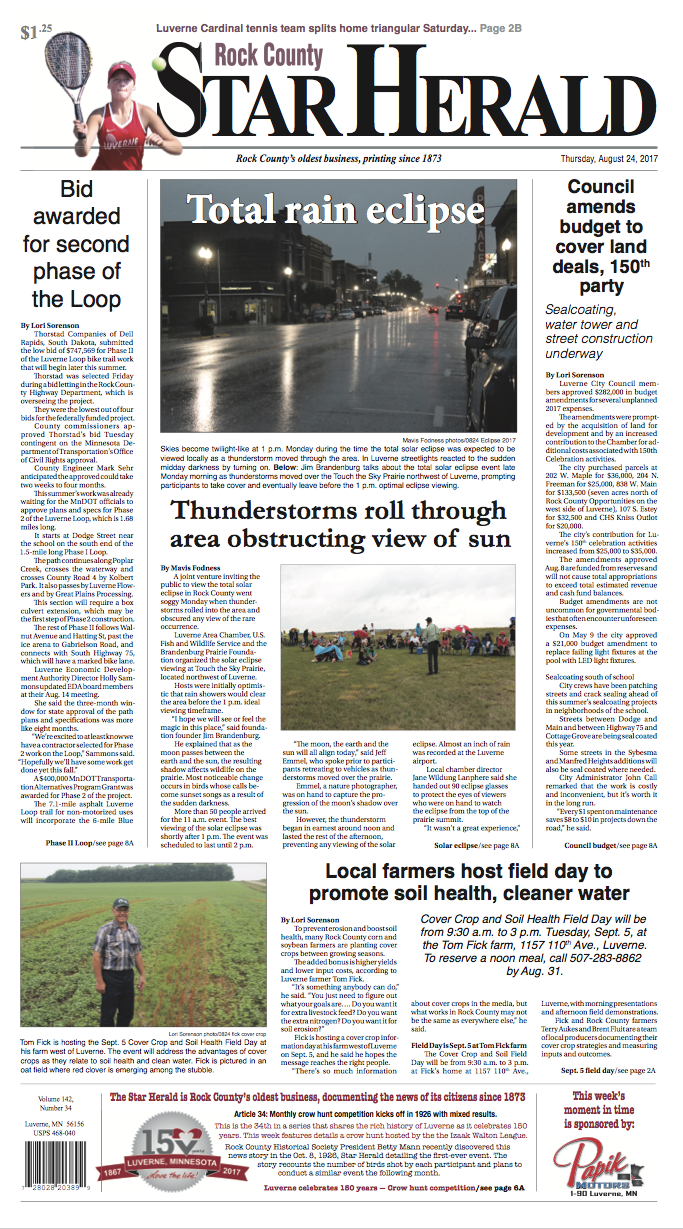
Total Rain Eclipse

A joint venture inviting the public to view the total solar eclipse in Rock County went soggy Monday when thunderstorms rolled into the area and obscured any view of the rare occurrence.
Luverne Area Chamber, U.S. Fish and Wildlife Service and the Brandenburg Prairie Foundation organized the solar eclipse viewing at Touch the Sky Prairie, located northwest of Luverne.
Hosts were initially optimistic that rain showers would clear the area before the 1 p.m. ideal viewing timeframe.
“I hope we will see or feel the magic in this place,” said foundation founder Jim Brandenburg.
He explained that as the moon passes between the earth and the sun, the resulting shadow affects wildlife on the prairie. Most noticeable change occurs in birds whose calls become sunset songs as a result of the sudden darkness.
More than 50 people arrived for the 11 a.m. event. The best viewing of the solar eclipse was shortly after 1 p.m. The event was scheduled to last until 2 p.m.
“The moon, the earth and the sun will all align today,” said Jeff Emmel, who spoke prior to participants retreating to vehicles as thunderstorms moved over the prairie.
Emmel, a nature photographer, was on hand to capture the progression of the moon’s shadow over the sun.
However, the thunderstorm began in earnest around noon and lasted the rest of the afternoon, preventing any viewing of the solar eclipse. Almost an inch of rain was recorded at the Luverne airport.
Local chamber director Jane Wildung Lanphere said she handed out 90 eclipse glasses to protect the eyes of viewers who were on hand to watch the eclipse from the top of the prairie summit.
“It wasn’t a great experience,” she said. “If it was a beautiful day, it would have been terrific.”
Tim Masters with the National Weather Service in Sioux Falls said the thunderstorms were widespread through the Tri-State area. Nebraska was the best location for viewers.
According to the weather service’s website, a total solar eclipse is a rare phenomenon due to its narrow path and brevity. The last total eclipse across the U.S. occurred in 1979.
At the ideal viewing time of 1 p.m., the city of Luverne was met with pouring rain and twilight-like darkness, which triggered streetlights to turn on.

Local farmers host field day to promote soil health, cleaner water

To prevent erosion and boost soil health, many Rock County corn and soybean farmers are planting cover crops between growing seasons.
The added bonus is higher yields and lower input costs, according to Luverne farmer Tom Fick.
“It’s something anybody can do,” he said. “You just need to figure out what your goals are. … Do you want it for extra livestock feed? Do you want the extra nitrogen? Do you want it for soil erosion?”
Fick is hosting a cover crop information day at his farm west of Luverne on Sept. 5, and he said he hopes the message reaches the right people.
“There’s so much information about cover crops in the media, but what works in Rock County may not be the same as everywhere else,” he said.
 
Field Day is Sept. 5 at Tom Fick farm
The Cover Crop and Soil Field Day will be from 9:30 a.m. to 3 p.m. at Fick’s home at 1157 110th Ave., Luverne, with morning presentations and afternoon field demonstrations.
Fick and Rock County farmers Terry Aukes and Brent Fluit are a team of local producers documenting their cover crop strategies and measuring inputs and outcomes.
“We’re tracking what kind of stand we get at a recommended rate, or if a lower rate is enough,” Fick said. “We’re in an era where every input cost counts.”
They’ll join a panel of other cover crop experts to share what they’re doing to improve their soil.
Discussion will include costs and herbicide considerations of cover crops, incorporating cover crops in traditional, strip till and no till operations, what to seed and how to utilize it for livestock.
Because cover crops improve nutrient levels in soil, less fertilizer needs to be applied.
“I am cautiously optimistic, hoping to be able to gradually reduce input costs as time goes on,” Fick said.
He encourages other farmers to try it. “It’s something they can do,” he said. “There’s enough resources out there they can see the benefits.”
Some producers are investing in new equipment to get the best results from cover crops, but Fick said farmers could still get good results from basic equipment.
“Ideally you want to use a no-till drill, but a regular drill works too,” he said, adding that it even works to plant rye from an end-gate seeder.
“Rye will grow if it’s sitting on top of the ground,” Fick said. “It doesn’t take any effort at all to grow cereal rye; it will germinate at 33 degrees.”
The idea is to plant vegetation in the fall so that it sprouts and provides cover during the early spring months before planting.
Fick said the choice of cover crops — red clover versus cereal rye, for example — is often driven by results growers are seeking.
Regardless of outcomes, cover crops are always good for soil health, Fick said.
“The idea is to keep something green growing on that soil for as long as you can,” he said.
 
Getting ahead of regulations to reduce nitrate contamination
As producers implement cover crops, Fick said they learn which varieties and what rates work for them in their specific fields and soil types.
And they can try a little at a time. “It doesn’t have to be a whole farm,” he said. “You can try it on a field or even a half a field.”
The Sept. 5 event includes a soil health demonstration showing moisture absorption from samples taken from a fence line (that has likely never been tilled), a field that has been cover-cropped and from a row-crop field.
Water is held longer in the fence line sample allowing nutrients to be absorbed. The row crop sample shows how quickly water passes through, taking valuable nutrients along with it.
“The goal is to get where soil absorbs moisture like it does in the fence line,” Fick said. “It’s about catching erosion and improving the structure and health of your soil.”
Doug Bos of the Rock County Land Management Office is helping with the Sept. 5 event.
“The cool thing is it’s actually planned by these farmers, with us facilitating,” Bos said. “They’re on a panel talking about what they’re doing.”
He said the information would be valuable to anyone currently experimenting with cover crops or thinking about trying them.
“I’ve learned that rye, radishes, turnips and canola planted the year before I plant beans is fantastic,” Bos said. “With cover crops before corn I’m still learning.”
Fick said he hopes plenty of people come out to his farm Sept. 5 because soil health is important for everyone.
“This all works together — soil health, wildlife habitat and water quality,” he said. “We all have the common goal of protecting our water.”
The Minnesota Department of Agriculture is currently rewriting its rules for nitrogen fertilizer management in order to reduce nitrate contamination in groundwater and drinking water.
In some areas of particularly vulnerable soil, fertilizers could be strictly monitored or even barred (see the related story).
Fick said the sooner producers get on board with better practices, the less affected they’ll be by regulations later on.
“People are becoming more and more aware that farms are one of the sources of excess nitrates, and we have to figure out a way to keep it in the soil and not running off the field or through the tile,” Fick said.
“In some countries in Europe they’re requiring cover crops, and we don’t want it to come to that. We’re trying to get ahead of it.”
The Cover Crop and Soil Health Day includes lunch for those who RSVP by Aug. 31. Call 283-8862.

Luverne's early history involved trading, stone carving, powwows

When Luverne’s founding father Philo Hawes decided to relocate his family home to the banks of the Rock River more than 150 years ago, he was following a well-worn path created by the area’s Native Americans.
Francis “Bud” Johnston and his wife, Rona, of Flandreau, South Dakota, brought a little of Luverne’s early history to life Saturday when the couple hosted an afternoon rock-carving workshop followed by an evening powwow event.
Luverne Area Chamber coordinated the two events in a yearlong celebration of Luverne’s 150th birthday.
Bud Johnston said Native Americans have been in the area for 2,000 years, but no tribe made the Luverne area home for very long.
“Almost all of our deciduous people were nomads,” he said. “Blood Run was a big trade area.”
Dozens of tribes would travel around the area’s wetlands to Blood Run located on the Iowa-South Dakota border. Their frequent trips developed an east-west corridor through the Luverne area, Johnston said.
Similarly a north-south corridor through the Luverne area was also created as Native Americans traveled to and from a sacred quarry site near Pipestone.
The soft red rock was collected and carved into peace pipes and other stone items by the Native Americans. The well-hidden location of the pipestone blended into the numerous outcroppings of similar-looking Sioux quartzite, a very hard stone.
The pipestone quarry is now part of the Pipestone National Monument.
Europeans like the Hawes family used the same corridors as they and other pioneers moved through the area. They often traded with the nomadic tribes.
“People bring in plates and peace pipes from family members,” Johnston said. “They received them as a ‘thank you’ for letting them stay (near their homesteads),” he said.
To protect and educate the public about Native Americans and their traditions, Johnston co-founded “Keepers of the Sacred Traditions” in 1996 in Pipestone.
More than 35 different tribes around the world are members and the Johnstons travel the world coordinating various activities including stone carving and powwows.
 
Popular Native American activity comes to state park
Stone-carving is a popular education activity for the Keepers organization, according to Johnston.
The activity is made easy, even for those who don't consider themselves artists.
“I was hoping they learn what a positive feeling the stone gives them,” he said.
Susan Marone received a very positive feeling as she took a preformed piece of pipestone and finished it into a butterfly in a hour.
“Every time we see a butterfly, we think of lost loved ones,” Marone said.
The Sioux Falls woman brought her grandson, Tyson Fesler, to the Saturday event. The two joined about a dozen others.
Participants used various rasps, rattail and finishing files to fashion an arrowhead, heart or a butterfly out of the pieces of pipestone
“I am surprised at how soft it is,” Marone said.
Johnston said the pieces were left over from making peace pipes.
“They (the pieces) were not pipe-worthy,” he said.
Heather Johnson of Luverne and her girls Ashlyn and Luella already knew of the stone’s softness, having watched the pipe-making demonstrations during a recent visit to the Pipestone National Monument
“I thought it would be fun to do it ourselves,” she said.
 
Powwows gathered various tribes in celebration
Almost 50 people witnessed a traditional powwow Saturday night with several audience members joining in on a group dance to end the hour-long presentation.
Rona Johnston said powwows are seen as social gatherings between tribes as they try to piece together various Native American traditions.
She said decades of government intervention to erase and/or combine reservations into smaller land parcels forced many Native Americans to abandon their traditions.
Powwows are slowly allowing adults to piece together different childhood memories by sharing their experiences among each other.
“They fill in the gaps for one another,” she said.
Dance styles are among the memory gaps.
Cammas Johnston and Pascal Quarrella joined their parents, Bud and Roma, in demonstrating a few of the dance styles.
Among the demonstrations were the grand entry, crazy dance, grass dance and hoop dance.
Each of the styles was accompanied by a story such as the one told before the grass dance.
“The 5-foot-tall prairie grass needed to be tapped down before a powwow,” Bud said.
Symbolism is featured in the hoop dance with the use of hula hoop-type props.
“We all hold one hoop that’s our hopes and dreams,” Cammas Johnston said before she intertwined five hoops in her demonstration.

Subscribe to

You must log in to continue reading. Log in or subscribe today.
