K.A.H.R. Foundation supports local students and teachers

Luverne High School students Jacinda Hustoft and Lindsey Roemeling attended a week of BestPrep’s Minnesota Business Venture (MBV) this summer, thanks to sponsorship from the local K.A.H.R. Foundation.
MBV is a business and career skills camp held each summer in partnership with the Herberger Business School at St. Cloud State University and the Donald McNeely Center for Entrepreneurship at St. John’s University.
Hustoft and Roemeling were among 324 students representing 100 schools who spent the week preparing for life after high school, developing workplace skills and improving their financial literacy skills.
More than 170 business professionals shared experiences and insights with the future workforce by volunteering as session presenters, mock interviewers, financial advisers and more.
For example, speakers from 3M, Allstate, General Mills, Pearson’s Candy and the Minnesota Timberwolves offered information on managing personal finance, experiences in entrepreneurship, business ethics and building one’s personal brand.
 
Teachers attend BestPrep technology workshop
Area teachers Diane Robinson, Corey Nelson, Jon Schomacker, Kristin Schomacker, Diana Erickson, Jodi Nelson, Susan Beers, Theresa Graff and Laura Endres attended BestPrep’s Technology Integration Workshop (TIW) sponsored by the KAHR Foundation.
They were among 61 other Minnesota teachers challenged to think in new ways about technology in the classroom July 31 through Aug. 3 at the University of St. Thomas Opus College of Business.
Each educator visited corporate workplaces in the Twin Cities metro and shadowed volunteer business partners to understand the workflow, environment and culture of businesses their students may one day work in.
For example, they were exposed to tech tools, websites and apps (such as Code.org, MakerSpaces, Virtual Reality and 3D Printing), and they developed a technology unit plan to bring back to their schools this fall.
The K.A.H.R. Foundation is a family foundation started in 2005 by Jeannine M. Rivet and Warren G. Herreid II for philanthropic endeavors.

Landowners have new options to meet Buffer Law requirements

Almost $5 million dollars is now available to support landowners in meeting the requirements of Minnesota’s buffer law.
Funds distributed to soil and water conservation districts (SWCDs) are to be used for cost-sharing contracts with landowners or their authorized agents to implement riparian buffers or alternative practices on public waters and public drainage ditches.
The 2017 legislation also recognizes that some landowners may have hardships (such as weather) in meeting the public waters deadline.
The added language allows for an eight-month extension for implementation when a landowner or authorized agent has filed a riparian protection “compliance plan.”
These plans need to be filed with local SWCD by Nov. 1, 2017. Compliance waivers offer a buffer deadline extension until July 1, 2018.
“Over 70 percent of the affected parcels in Rock County are currently in compliance with the buffer law,” said Arlyn Gehrke of the Rock County Land Management Office.
“The eight-month extension option will allow remaining buffer areas to be seeded in the spring of 2018 and still comply with the law.”
The state buffer law requires a buffer on public waters by Nov. 1, 2017, and a buffer on public drainage ditches by Nov. 1, 2018.
For more information on the buffer law, including the cost-share program, contact the Rock County Land Management Office and Soil and Water Conservation District at 507-283-8862.
Information is also available at bwsr.state.mn.us/buffers.

Impact on infrastructure

On Sunday, Aug. 27, Sen. Amy Klobuchar, along with Luverne and Rock County officials, toured the construction underway on the 4-million-gallon reservoir being constructed southwest of Luverne. Pictured are (front from left) Red Arndt, Klobuchar, Rock County Commissioner Sherri Thompson, Lewis and Clark’s Troy Larson, (back) Luverne City Councilwoman Caroline Thorson and County Commissioners Stan Williamson and Gary Overgaard. The group discussed the impact of federal infrastructure projects like the Lewis and Clark Rural Water System on Luverne and Rock County — specifically the tru Shrimp Luverne Bay Harbor coming in 2019.

Fall duck and goose seasons opening around state

Minnesota waterfowl season opens Saturday, Sept. 23.
“Habitat conditions look good in most areas, wild rice reports are good for hunters in the northern portions of the state and waterfowl numbers are favorable,” said Steve Cordts, waterfowl specialist with the Minnesota Department of Natural Resources.
The waterfowl season will open with similar bag limits and season dates that were in place last year. The early goose season will open Saturday, Sept. 2, and extend through Sunday, Sept. 17.
 
Duck seasons and limits
Duck season will again be open for 60 days in each of the three waterfowl zones.
In the north zone, duck season is Saturday, Sept. 23, through Tuesday, Nov. 21.
In the central zone, duck season is Saturday, Sept. 23, through Sunday, Oct. 1, closes for five days, then reopens Saturday, Oct. 7, and runs through Sunday, Nov. 26.
In the south zone, duck season is Saturday, Sept. 23, through Sunday, Oct. 1, closes for 12 days, then reopens Saturday, Oct. 14, and runs through Sunday, Dec. 3.
The daily bag limit for ducks remains at six per day and individual species limits are identical to those used last fall.
Limits are four mallards (only two can be hens), three scaup, three wood ducks, two redheads and two canvasbacks, except the pintail bag limit was reduced to one per day and the black duck limit increased to two per day.
 
Canada goose seasons and limits
The goose season and limits will also be the same as last fall.
“Our Canada goose population in the state is healthy and it looks like there will be lots of young geese this fall, so hunters should expect a good season,” Cordts said.
“And the seasons are long and extend late into December or January, depending on where you hunt — so lots of opportunity to participate.”
The early September goose season will open statewide on Sept. 2 and run through Sept. 17. Bag limits for dark geese are five per day statewide. A $4 permit is required to hunt geese during the September season.
The restriction prohibiting hunting within 100 yards of surface water remains in effect in the northwest goose zone, Carlos Avery Wildlife Management Area, Ocheda Lake Game Refuge and an area surrounding Swan Lake in Nicollet County.
Early season goose hunters should consult the 2017 Waterfowl Supplement for zone maps and additional details.
Minnesota’s regular goose season will open in conjunction with the duck season statewide on Sept. 23, with a bag limit of three dark geese per day the entire season.
“Dark” geese include Canada geese, white-fronted geese and brant. Goose season will be closed in the central and south duck zones when duck season is closed.
 
Other seasons
Youth Waterfowl Day will be Saturday Sept. 9. The season for sandhill cranes runs Saturday, Sept. 16, through Sunday, Oct. 22, in the northwest goose and sandhill crane zone only.
For more detailed information, the 2017 waterfowl hunting regulations are available online at mndnr.gov/waterfowl.

Local Minnesota State Fair 2017 results

Rock County 4-H’ers joined representatives from the state’s 87 counties to exhibit 2,843 animals during this year’s Minnesota State Fair livestock encampment Aug. 23-27.
Five local 4-H’ers received champion or reserve champion honors during the event. They are Justin Mente, champion cow/calf pair and champion prospect market calf intermediate showperson; Ryleigh Beers, reserve champion shorthorn plus heifer; Trevor Mente, reserve champion Maine-Anjou heifer; Jacob Raak, reserve champion Ayrshire cow; and Trey Baustian, reserve champion lightweight market lamb and fourth place showperson.
Purple ribbons were awarded to Cassie Flanagan, middleweight market meat goat; Christian Kruse, lightweight black-face market lamb; Riley Baker, middleweight black-face market lamb; and Hallie Hough, crossbred market swine;
Recipients of blue ribbons were Tommy Norman, registered junior yearling breeding heifer; Michael Kinsinger, commercial junior yearling breeding heifer; Tyler Reisdorfer, Red Angus junior yearling breeding heifer; Leah Kruse, Hereford junior yearling breeding heifer; Dylan Mente, prospect calf and fourth-place senior prospect calf showperson; Andrew Raak, red-and-white winter or fall calf and dairy showcase finalist; Drew Fick, prospect beef steer; Payton Fick, prospect beef steer; Tory Knobloch, slick-shown market steer; Sean Elbers crossbred market beef; Joshua Raak, spring yearling Holstein; Brooke Feit, large breed senior buck and advanced rabbit project interview finalist; Hunter Baker, middleweight black-face market lamb; Adayla Rouzer, speckle-face market lamb; Mira Uithoven, speckle-face market lamb; Trista Baustian, crossbred February gilt; Tyler Fick, Duroc market barrow; and Aleck Schoeneman, crossbred market barrow.
Earning red ribbons were Karly Kruse, Hereford spring calf breeding heifer; Hannah Kruse, Hereford market steer and individual livestock demonstration; Whitney Elbers, slick-shown market steer; Caleb Raak, Guernsey winter or fall calf; Breanna Richters, senior yearling breeding doe; Moriah Flanagan, senior meat breeding doe kid and meat goat project finalist; Gracie Sandbulte, Mini Rex senior buck; Payton Bork, New Zealand junior buck; Tacey Baustian, lightweight black-face market lamb; William Stegenga, market gilt and fourth-place senior showman; and Tanner Baustian, market gilt.
 
Beers receives livestock association scholarship
Each year the Minnesota Livestock Breeders’ Association Scholarship is awarded to 4-H and FFA youth who are active members and exhibitors during the year of application.
Rock County 4-H’er Ryleigh Beers received a $1,000 scholarship based on her leadership experience and personal growth achievement along with academic excellence and outstanding livestock production.
In 2017, 31 scholarships ranging from $1,000 to $4,000 were awarded.

Local Minnesota State Fair 2017 results

Conference judging is used at the Minnesota State Fair to determine ribbon placings for purple, blue, red and white. A purple ribbon is the highest ranking given by judges in the general project area.Two Rock County 4-H’ers earned purple ribbons during their general project encampment.Receiving purple ribbons were Kaylie Ossefoort, home environment grades 9+, and Alexandra Hartman, cats grades 9+.Blue ribbons were earned by Burke Johnson, computers; Elisabeth Kelm, food revue; Joni Vander Beek, needle arts grades 9+; Allison LaRock, performing arts grades 6-8; Josie Scholten, performing arts grades 9+; Erika Dysthe, photography; Ashlyn Johnson, photography; Magnolia Juniors 4-H Club, club banner; Livewires 4-H Club, community pride; Sage VerSteeg, crafts grades 9+; Gretchen Jacobsma, food and nutrition grades 6-8; Joshua Wiersema, food and nutrition grades 6-8; Deven Porter, foods and nutrition grades 9+; Elisabeth Kelm, food review grades 6-8; Katie Fick, health grades 9+; Austin Ossefoort, home environment grades 6-8; Joni Vander Beek, needle arts grades 9+; Allison LaRock, performing arts grades 6-8; Josie Scholten, performing arts grades 9+; Erika Dysthe, photography grades 6-8; Ashlyn Johnson, photography grades 6-8; Morgan Gonnerman, clothes you buy; Emily Malson, citizenship; and Brianna Jonas, clothes non-garment grades 9+.Red ribbons were awarded to Krista Burkeman, geology grades 6-8; Cassie Flanagan, crafts grades 6-8; Brooke Feit, fine arts grades 9+; Mia Wenzel, quilting grades 6-8; Aisha Porter, wildlife grades 9+; and Alexa Chesley, clothes you make grades 9+.Candace Porter, photography grades 9+, received a white ribbon.

Speaking up on behalf of our neighbor

The story of Jesus’ encounter with the Canaanite woman on the border of the regions of Tyre and Sidon found in Matthew 15:21-28 came up as the story to be read in church a couple of weeks ago for those churches that use the Revised Common Lectionary. And it’s had me thinking about advocacy or speaking up, publicly on behalf of another.
In this story the woman, a foreigner to Jesus, cries out to him for mercy, asking that he would free her daughter from the demon that is tormenting her. At first Jesus ignores her. He keeps on walking, not even acknowledging her presence, similar to the way we may act when we encounter a stranger on the street who is asking us if we can spare a little money. Eventually the woman blocks Jesus’ path, kneels at his feet and cries out, “Help me!”
This is when the exchange gets heated. Jesus responds with an insult, “It is not fair to take the children’s food and throw it to the dogs.” (Matthew 15:26). But seemingly unfazed, the woman persists. “Yes, Lord, yet even the dogs eat the crumbs that fall from the master’s table.” (v. 27) And with that, Jesus proclaims, “Woman, great is your faith!” and her daughter is healed immediately.
This story is scandalous for a number of reasons, one of which is that the woman advocates for her daughter persistently enough that Jesus changes his mind. To those of us who’ve learned about an unchanging God, this can be puzzling. But there are many instances throughout the Holy Story in which God changes God’s mind. God changes God’s mind about destroying all the earth in the flood story (Genesis 6). God changes God’s mind, much to Jonah’s dismay, when God decides not to destroy Nineveh after the entire city repents (Jonah 3). Moses convinces God to spare the people in the wilderness after they create the golden calf (Exodus 32). Abraham bargains with God on behalf of the people of Sodom (Genesis 18). God changes how God interacts with humanity many times throughout scripture. Perhaps you’ve noticed a pattern: it’s always toward mercy and forgiveness, and it often involves someone advocating or appealing to God on behalf of someone else.
The woman cried out to Jesus for her daughter. Moses pleaded for forgiveness on behalf of the people. Being an advocate on behalf of others  — giving a voice to the people whose struggles are not often understood and known — is part of the way of life for the children of God. As people of God we are called to listen to our neighbors, to learn about their needs, and to speak up on their behalf when their needs are not getting met. Being advocates for each other helps spread the grace and mercy of God to all of God’s creation.

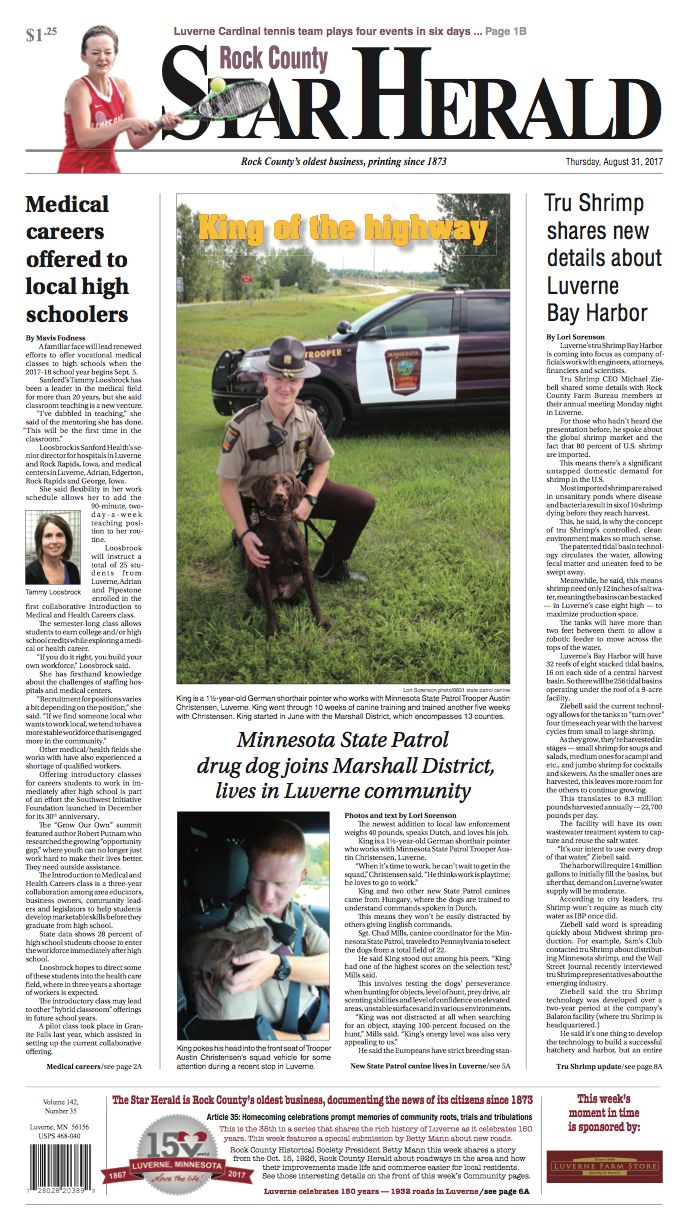
King of the Highway

The newest addition to local law enforcement weighs 40 pounds, speaks Dutch, and loves his job.
King is a 1½-year-old German shorthair pointer who works with Minnesota State Patrol Trooper Austin Christensen, Luverne.
“When it’s time to work, he can’t wait to get in the squad,” Christensen said. “He thinks work is playtime; he loves to go to work.”
King and two other new State Patrol canines came from Hungary, where the dogs are trained to understand commands spoken in Dutch.
This means they won’t be easily distracted by others giving English commands.
Sgt. Chad Mills, canine coordinator for the Minnesota State Patrol, traveled to Pennsylvania to select the dogs from a total field of 22.
He said King stood out among his peers. “King had one of the highest scores on the selection test,” Mills said.
This involves testing the dogs’ perseverance when hunting for objects, level of hunt, prey drive, air scenting abilities and level of confidence on elevated areas, unstable surfaces and in various environments.
“King was not distracted at all when searching for an object, staying 100-percent focused on the hunt,” Mills said. “King’s energy level was also very appealing to us.”
He said the Europeans have strict breeding standards, much higher than the United States, which makes it easier to find dogs with the drive needed for police work, such as hunt and air scenting abilities.
Christensen said these breeding traits also mean they demand extra attention from their human companions.
“They have more drive and more energy, which also means they’re more willing to work,” he said.
“He’s very focused when you give him the command to hunt for drugs. He won’t quit until he sources the smell. He’ll go into what we call a ‘quick sit’ and stare at the source of the odor.”
Given the choice between food and toys, good drug dogs often choose play, which is what they think they’re doing when they’re sniffing for drugs.
The Minnesota State Patrol now has 15 canine teams trained to detect narcotics and one team trained to detect explosives.
Some assist with apprehending suspects, but King is trained only as a drug dog — he isn’t trained to bite or detain people.
“He’s good with kids and he gets along with other dogs,” said Christensen, who also has a female border collie at home. “He’s a pet at home, and work is a game to him.”
He said King spends 10 hours a day with him in the State Patrol SUV, and if a drug sniff isn’t required, they'll take a break from the road to get some training exercise.
In addition to working with King at home and on patrol, Christensen attends monthly canine training and works monthly canine saturations with other agencies.
“It’s a lot of work, but I grew up with German shorthair pointers, and I’m used to training them for pheasant hunting,” he said. “Instead of hunting pheasants, we’re hunting drugs.”
Since King started working with Christensen in June, they’ve assisted with several felony-level narcotics arrests, mostly on the interstate and state highways.
Christensen said a good share of narcotics seizures result from regular roadside traffic stops. King gets called to action if the driver or passengers behave suspiciously.
He is trained to alert for four basic controlled substances — meth, cocaine, marijuana and heroine — and their derivatives.
According to Mills, King is the first State Patrol canine in 10 years to work in the Marshall District, which encompasses 13 southwest Minnesota counties.
“We’re pretty excited to get one down there,” Mills said. “We now have two dogs on I-90 — by Luverne and by Rochester — so we have one on each side of the state. We hope to get a third one soon.”
Rock County hasn’t had a law enforcement dog for five years, and Christensen said he’s been introducing King to the community.
For example, he’s reached out to local school administrators.
“They’ll let us do some training in the school, and we’ll help out if they need us for locker searches,” he said.
Sheriff Evan Verbrugge said he’s glad to have the canine team in Rock County.
“Any time you have a drug dog in your area, those who deal drugs will know it,” Verbrugge said. “And that will benefit all of Rock County.”
From January through June this year, drug dogs have helped troopers seize 1,150 pounds of marijuana, 116 pounds of meth, 17.5 pounds of cocaine and 13.5 pounds of heroin.
This included searches of 353 vehicles, 20 residences, five schools and two parcels.

Subscribe to

You must log in to continue reading. Log in or subscribe today.